Winner-take-all games share several similarities with what James P. Carse described as "finite games" in his brilliant book Finite and Infinite Games from 1986.
A finite game is played solely for the sake of determining a winner. To do so, a finite game must have rules, participants, and a set of boundaries for them to play the game in.
All competitive sports are finite games. So is all of politics. Wars are also finite games, as is trading in the financial markets.
If there can only be one winner — and there must be at least one or multiple losers in order to declare them the winner — you're playing a finite game.
Add to this the "winner-take-all" dynamic, which simply means that the winner gets 10x, 100x, sometimes 1000x more rewards than #2, and you have a pretty tough world to play in altogether.
Everybody loves strawberries — but if you don't sell vanilla, you better not open an ice cream store at all.
Thankfully, not everything is a winner-take-all game. Some arenas and industries provide enough room for everyone to play. Let's call these "win-win games."
If your success does not depend on someone else failing, chances are, it's a win-win game.
Building a business can be a win-win game. So can be creating valuable information and sharing it online. In the world of arts and entertainment, there are still win-win games to be played.
Sadly, even win-win markets start to look more and more like winner-take-all games.
Cristiano Ronaldo became the most followed person on Instagram with around 144 million followers in 2018. Since then, he hasn't left the #1 spot. Instead, he has grown to an insane 627 million, ever widening the gap to #2.
If Cristiano Ronaldo founded a country and all of his followers became citizens, it would immediately be the 3rd-largest country in the world.
This is the power of winner-take-all games, and that power now affects almost everything, for better or for worse.
Sure, you can still make a living as a musician with 10,000 followers. You can run a small bakery that only serves your suburb. You can be a slightly above average writer and get mediocre gig after mediocre gig from mid-sized brands.
But existence around the average gets harder by the day, and the only way out — to sustainability, success, and especially greatness — leads through quality. Through better. Through improving what's in your head.
The way to better, to succeed in winner-take-all games, is called "deliberate practice" — and the Four Minute Books Lifetime Membership will help you make it a habit.
Deliberate practice is not just practice. It's practicing to improve.
In his book Peak: Secrets from the New Science of Expertise, high-performance researcher Anders Ericsson says that if your practice doesn't have these 4 traits, it's not deliberate:
Clear, specific goals. For a chess player, it might be to get their Elo rating above 2,500.
Focus. For a writer, that could mean writing with undivided attention for at least 30-90 minutes.
Stretching, aka going beyond what you can normally do. If you're a guitar player, you might try to learn a song with a long, complicated intro that you've never played before.
Immediate feedback. You need a way to instantly recognize and correct your mistakes, like looking up answers to a vocabulary test, adjusting the notes while playing a song on piano, or comments from readers to tell you how well your essay was structured.
In chess, the only deliberate practice comes from serious study. When you play real opponents, be it online or at a tournament, there's no time for stretching and feedback.
Only if you study your moves after the fact will you get better. You could re-play your games if you record them and correct your mistakes. You could also use books, chess bots, and custom game setups to always design the right challenge you need to level up at every stage.
Yesterday, we talked about how to use the Four Minute Books Lifetime Membership to become a polymath. To study a wide variety of subjects every day for 4 minutes in order to develop broad, cross-discipline expertise.
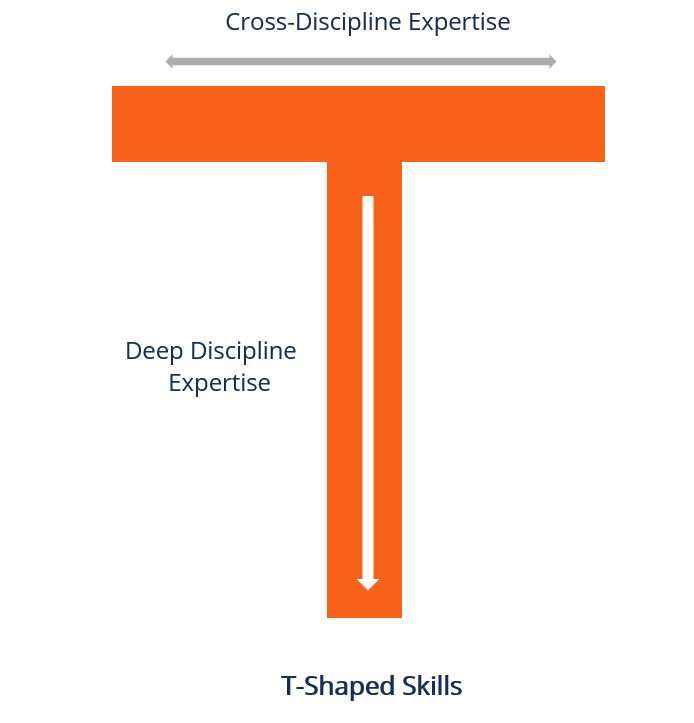
In the ideal model of "T-shaped learning," pictured below, the 4-minute polymath approach represents the bar at the top, and even though it's not meant to go super deep on every topic, we've built some deliberate practice into that regardless.
By reflecting on your daily book lessons and completing small action items to try and implement them into your life, you gain the immediate feedback and stretching capabilities that really cement the lessons and truly add them to the idea pool inside your mind.
But once you want to go deep on a subject, be it personal finance, marketing, or philosophy, deliberate practice becomes not just helpful but essential.
You can't become a master of logistics by just keeping the machines running at your automotive plant. You can't win ever bigger tennis tournaments by playing against the same competitors again and again. And you can't write essays that attract millions of readers by going with the flow and publishing what you feel like every day.
If you want to consistently accomplish things worth mentioning, anything remarkable in your field or chosen arena, you need to practice deliberately in order to get better and better at what you're trying to do.
For one, thanks to our catalog of over 1,300+ book summaries and audios, you have everything you need to design a compelling deliberate-practice curriculum on almost any topic.
There are books about sales. Books about business strategy. Books about creativity, productivity, and relationships. If you slice and dice their summaries right, you can learn how to become a great marketer, how to become an exemplary parent, or how to become the most creative person you know.
But what's more, for the new, monthly Membership v2 going forward, we've already started working out these curriculums behind the scenes.
We'll map out the deliberate-practice path to various goals for you using the best lessons from the best books on the subject, and then we'll deliver them to you in an easy, 4-minute format you can fit into your busy everyday life.
For example, based on the work I did while writing The 4 Minute Millionaire alone, there'll be 5 email courses to help you accomplish various financial goals, from changing your money mindset to how you approach debt and savings to which formulas you use to choose your investments.
Our goal is to make more and more of these, based on the feedback of our members — as you can see, we, too, have a deliberate practice!
If you sign up now, not only will you not have to pay on a monthly basis, you'll also be in the very first group that gets to choose the direction of which T-shaped skills we'll work on first together.
That's how you become a grandmaster of chess, a world-class athlete, or a highly successful entrepreneur — and if you persist in your deliberate practice long enough, maybe one day, we'll even remember your name.
I hope to work on that practice with you, and I'll see you on the other side.


 Posts
Posts




0 Comments