You know what's a funny yet kinda terrifying pair of statistics?
A University of California study found that "the typical office worker is interrupted or switches tasks, on average, every 3 minutes and 5 seconds."
That very same study concluded that "it takes an average of 23 minutes and 15 seconds to get back to the task."
Here's the combination of those facts in one simple graphic:
How does that work? You're right. It doesn't!
If it takes 7 times as long to properly focus on a task as it takes for you to be interrupted again, you'll spend your entire working day in a haphazard, semi-dazed limbo state of trying to somehow, sorta, maybe get a few things done.
We all know that state. Ugh. I shudder just thinking about it. But that's what productivity books are for, isn't it? That's why we read books like Essentialism and Getting Things Done and Feel-Good Productivity. And boy, do they deliver in the solutions department! We learn about...
Time-boxing
Time-blocking
Segmented to-do lists
The Pomodoro technique
Mindfulness breaks
Eliminating notifications
Silencing our phone
Blocking distracting websites
Declaring our goals publicly for accountability
Co-working for even more accountability
Supporting each other with encouraging words
Gamifying our output with milestones
Celebrating the little wins
Motivating ourselves with inspiring quotes
Listening to the right music that helps us focus
...and a lot more. So what's the problem? Why aren't we all happy and productive? Why aren't we all whistling while we work and clocking out at 3 PM?
I think it's simple: We're human. We forget. We slack. And we fail to turn all those solutions into actual habits we perform without thinking.
On some days, we avoid doing the right things because they're too hard. On others, we just can't remember all of them. Often, we learn about different productivity techniques at different times, and as a result, our setup is always incomplete.
We do the Pomodoro technique for a month here, co-working for a month there, but we never experience the full benefit of applying all the brilliant and helpful techniques we know about at the same time — let alone do we turn them into a comprehensive habit stack that eventually becomes part of who we are; a smooth operating system that runs completely on autopilot.
The simplest way I can describe theSukha is that it's the last productivity app you'll ever need.
Why? Because it ensures you apply all 15 of the above techniques and then some, simultaneously, automatically, every single time you try to get something done. It's absolutely brilliant! Finally, someone has combined all of the best strategies and tactics into one coherent solution.
That someone is Steven Puri, by the way, Sukha's founder. Steven used to work in the movie business (think Bruce Willis blockbusters!), and he only found out that he has ADHD relatively late in his life. With the Sukha, he built the productivity tool he needed for himself, and it shows. The vibe of the app — its graphics, sounds, and overall feel — is exactly as calm and relaxed (yet still fun) as the Steven I've come to know.
When you start your computer in the morning, open the Sukha app (it also works in the browser, but the desktop app is best).
Enter your to-dos for the day in the right-hand sidebar (with estimates for how long you think each item will take).
Press play, and let the focusing begin!
Of course, there's a lot more you can do, but if you want to quickly get a feel for what this app can do for you (*activates Mandalorian voice*), this is the way.
Once you press play, a timer will start, the chat will disappear, and your AI coach (yes, you'll get your own private coach based on a real person's input) will say a few words to get you into flow.
See the QR code below the timer? If you scan that with your phone, it will open a specific page in your browser and keep it there. That way, your AI coach will know when your phone is luring you in with distractions, and can remind you to return to the task at hand.
Your coach will also remind you of how much time you've spent on your task on occasion, and after 25 minutes (or however long you set your work blocks), they will encourage you to take a 5-minute break (and perhaps a breathing exercise if you feel like it).
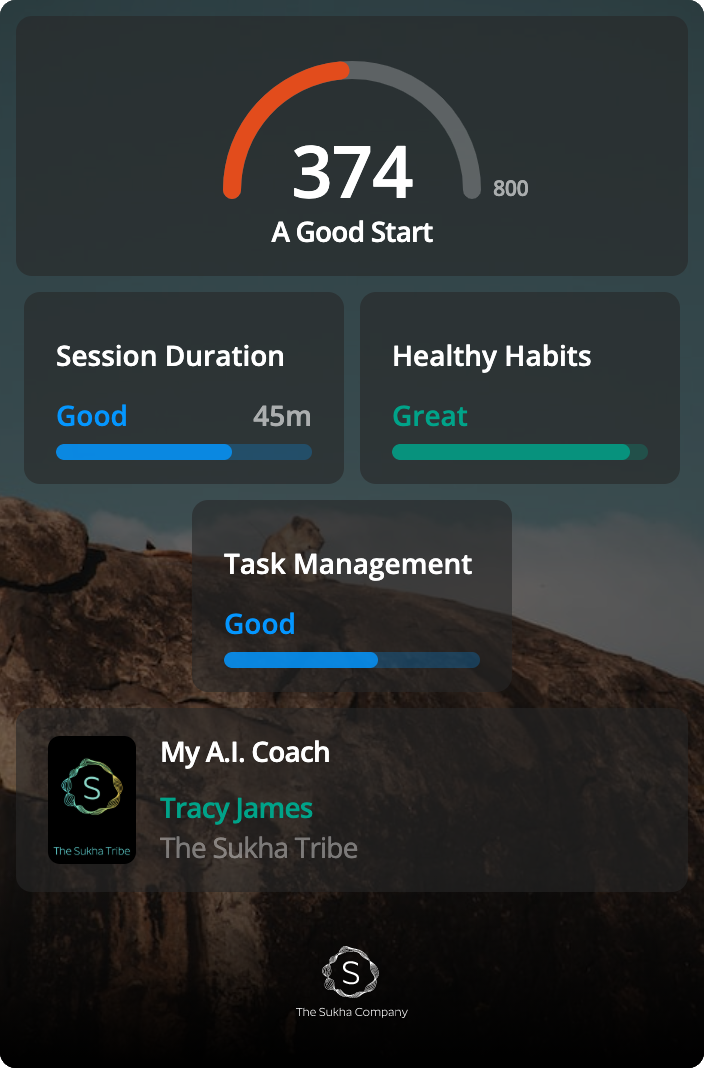
When you mark your first task of the day as done, the Sukha will encourage you to share it in the group chat, where everyone reacts to one another's accomplishments with emojis. And once you press stop and your session ends, you'll get a productivity score!
If you work at least 15 minutes on any given day, you'll get a small reward, like a score multiplier, an inspiring quote, or a short story. Plus, you'll start your journey on the daily, monthly, and weekly leaderboard. On some days, like today, you can even find me towards the top :)
All in all, the system is so effective, I got hooked right away. Here's my Sukha streak from the past 2.5 months — as you can see, I've used the app every single day!
Since the Sukha is organized into groups, you can pick your own unique flavor of working atmosphere. Each group comes with a different AI coach.
There's technology author Nir Eyal's group around being indistractable, Noah Kagan's upbeat group for marketers, and Cassidy Williams' Freakin' Nerds group for engineers, among many others! You might even find your favorite author in there and be able to hear their voice encourage you as you work. How cool is that?
Plus, if you join the main Sukha group, where I'm in right now, you can also co-work with me every single day. How does that sound? I'd love to get stuff done and have an awesome 2024 together with you and other Four Minute Books readers (perhaps we could even make our own group down the line!).


 Posts
Posts




0 Comments